
European soccer is more than just a game—it’s a legacy of passion, dominance, and unforgettable moments. From the thunderous roar in Madrid’s Santiago Bernabéu to the electric nights at Anfield, the continent breathes football like no other. And as someone who’s spent years watching, researching, and writing about the beautiful game, I’ve come to realize that the magic of football often begins with one question: Which are the best European soccer teams?
Now, that’s not an easy question to answer. Some clubs have trophy cabinets that sparkle with history, while others have only recently risen to the top with tactical brilliance and financial firepower. But one thing’s for sure—whether it’s Real Madrid chasing their next Champions League title, or Manchester City rewriting modern football, these teams don’t just play; they define eras.
In this article, I’ll walk you through the most successful European soccer teams, backed by hard data, iconic performances, and yes—plenty of personal insights. You’ll also get to know the most famous football clubs in Europe, the leagues they dominate, and the secrets behind their long-standing legacy or explosive rise.
Comparative Table of Top 10 European Clubs – Titles, League, Founded Year
| Club Name | Country | Domestic League | Total Major Titles* | Founded Year |
|---|---|---|---|---|
| Real Madrid | Spain | La Liga | 100+ | 1902 |
| FC Barcelona | Spain | La Liga | 90+ | 1899 |
| Bayern Munich | Germany | Bundesliga | 80+ | 1900 |
| AC Milan | Italy | Serie A | 50+ | 1899 |
| Liverpool FC | England | Premier League | 65+ | 1892 |
| Manchester United | England | Premier League | 70+ | 1878 |
| Juventus | Italy | Serie A | 65+ | 1897 |
| Inter Milan | Italy | Serie A | 45+ | 1908 |
| Chelsea FC | England | Premier League | 30+ | 1905 |
| Ajax Amsterdam | Netherlands | Eredivisie | 35+ | 1900 |
If you’re a football nerd like me—or even just someone curious about which clubs make the cut—you’re in the right place. Let’s kick off with what really defines greatness in European club football.
What Defines the Best European Soccer Teams?
Being labeled as one of the best European soccer teams doesn’t just come from winning a match or two. Over the years, I’ve realized it takes a lot more than just one good season to make it to the top. Here’s what really separates the legends from the rest.
Trophies and Achievements
Let’s be honest—silverware matters. The teams we look up to today didn’t just get famous by chance. They earned it by winning domestic leagues, dominating in the UEFA Champions League, and performing under pressure. Clubs like Real Madrid and AC Milan have built their identities around these wins.
In football, history and legacy are often written in gold. A club that consistently lifts trophies sends a clear message—they’re built to win.
Consistency Over Time
Being great for one season is impressive. But staying great over decades? That’s legendary. I’ve seen clubs rise fast, but only a few manage to stay at the top. What makes these teams stand out is their ability to perform consistently in both domestic and international tournaments.
Just look at Bayern Munich or Manchester United—they’ve faced ups and downs but always come back stronger. It’s that kind of long-term dominance that earns true respect.
Squad Strength and Fan Culture
Behind every great team is a world-class squad. Teams with deep benches, solid academies, and smart transfer policies tend to go far. Think of how Barcelona’s La Masia academy shaped players like Messi, Xavi, and Iniesta. Youth systems like these keep clubs strong across generations.
And let’s not forget the fans. A powerful fanbase doesn’t just support; it creates legends. Clubs like Liverpool and Borussia Dortmund have loyal supporters who turn stadiums into fortresses.
Legendary Clubs That Shaped European Football
Some teams didn’t just win trophies—they changed how the game is played, watched, and loved. These clubs helped shape European football history, building legacies that still inspire today.
Here are the giants whose names are etched in gold.
Historical Performance in UEFA Competitions
| Club Name | Country | UEFA Champions League Titles | Total European Titles | First UEFA Title Year |
| Real Madrid | Spain | 14 | 20 | 1956 |
| AC Milan | Italy | 7 | 14 | 1963 |
| FC Barcelona | Spain | 5 | 12 | 1992 |
| Bayern Munich | Germany | 6 | 14 | 1974 |
| Liverpool FC | England | 6 | 13 | 1977 |
| Manchester United | England | 3 | 6 | 1968 |
| Ajax Amsterdam | Netherlands | 4 | 9 | 1971 |
| Inter Milan | Italy | 3 | 6 | 1964 |
| Chelsea FC | England | 2 | 6 | 2012 |
| Juventus | Italy | 2 | 6 | 1985 |
These clubs didn’t just stack trophies—they sparked revolutions. Real Madrid, for example, didn’t just dominate Europe; they helped make the Champions League what it is today. You can see that dominance here on UEFA’s official history page.
And clubs like Ajax redefined youth development, creating systems that trained some of the world’s best players.
I grew up watching many of these teams play under the lights of Europe. Every goal, every final, every comeback—they’re not just moments in football. They’re chapters in history.
Modern-Day Dominance: Current Top Teams in Europe
European football isn’t just about the past. Right now, a new generation of teams is making history. I’ve followed these clubs closely over the last few seasons, and their growth has been incredible. They’re not just winning games—they’re setting new standards in football.
Manchester City
Let’s start with the current kings of Europe. Manchester City have built a footballing machine under Pep Guardiola. Their tactical brilliance, squad depth, and control over matches are unmatched. Winning the UEFA Champions League in 2023 was the cherry on top.
I’ve watched them evolve from a mid-table Premier League side to a European powerhouse. It’s a perfect example of smart investment meeting football intelligence.
Paris Saint-Germain (PSG)
PSG have brought glamour to the game. With superstars like Mbappé and Neymar, they’ve dominated Ligue 1 and made several deep runs in Europe. Their 2020 Champions League final appearance showed they’re more than just a flashy club—they’re serious contenders.
While they still chase their first Champions League title, their influence on the modern game is huge. Their brand is now global, and their squad is packed with world-class talent.
Napoli
Napoli surprised everyone with their incredible 2022–23 Serie A title run. Watching them play was like watching poetry in motion. Victor Osimhen and Khvicha Kvaratskhelia became fan favorites, and their high-pressing style thrilled fans across Europe.
It’s great to see Italian football back on the rise, and Napoli is leading that charge.
Other Teams Making Waves
Several other clubs are also turning heads:
- Inter Milan – Made the 2023 UCL Final and showed strong tactical discipline.
- Arsenal – Rebuilding under Arteta and finally back in top form.
- RB Leipzig – A modern German club with great scouting and youth policy.
- Club Brugge – Their performances in the UEFA Champions League group stages have gained attention.
- Benfica – Known for their academy, they regularly reach the knockout stages and export top talent.
These teams are writing the next chapter of European football, and I can’t wait to see how far they’ll go.
Top Leagues Fueling These Giants
The best clubs don’t rise in isolation. They grow in the toughest leagues, compete with strong rivals, and sharpen their skills weekly. I’ve followed every major European league, and each one has its own flavor.
Most Clubs from Each League in Top 20 UEFA Rankings
| League | Country | Top Clubs in UEFA Top 20 |
| Premier League | England | Manchester City, Arsenal, Liverpool, Chelsea, Manchester United |
| La Liga | Spain | Real Madrid, FC Barcelona, Atlético Madrid |
| Serie A | Italy | Napoli, Inter Milan, AC Milan, Juventus |
| Bundesliga | Germany | Bayern Munich, Borussia Dortmund, RB Leipzig |
| Ligue 1 | France | PSG, Marseille, AS Monaco |
Let’s break them down:
English Premier League (EPL)
The Premier League is the most watched and arguably the most competitive. Every match is intense, and even the mid-table teams are strong. Financial power and smart recruitment have helped English clubs dominate Europe recently.
I’ve always loved how unpredictable the EPL is. One week you beat the leaders, the next you lose to a relegation team. That chaos is pure football joy.
La Liga
Spain’s top division is all about technique and flair. La Liga gave us the golden age of El Clásico, and clubs like Real Madrid and Barcelona continue to shine. Their style of play is elegant but deadly.
What makes La Liga unique is its mix of traditional footballing values and modern tactics. And of course, it’s the home of the most successful club in UCL history—Real Madrid.
Serie A
Italian football is back. Serie A is known for its tactical battles, strong defenses, and legendary clubs. Watching Napoli and Milan shine in recent seasons has brought back the glory days.
The league also focuses heavily on strategy. I admire how they balance youth and experience, tradition and innovation.
Bundesliga
The Bundesliga is where talent meets efficiency. Clubs like Bayern Munich and Borussia Dortmund are known for their player development. It’s a league with great atmosphere, packed stadiums, and high-scoring games.
Their fan culture is one of the best in the world. Every time I see the Yellow Wall at Dortmund, I feel the raw energy of football.
Ligue 1
Often underrated, Ligue 1 has produced some of the world’s best players. PSG might dominate, but clubs like Monaco and Lyon have rich histories too.
This league is a goldmine for scouting. So many stars—like Mbappé, Hazard, and Benzema—started here.
Let me know when you’re ready to move on to the next two sections:
- What Makes These Teams Stand Out?
- Future Giants – Rising European Clubs to Watch
What Makes These Teams Stand Out?
After years of watching European football, I’ve noticed something special about the top clubs. It’s not just about winning games. It’s about how they win, how they build, and how they stay ahead. Let’s break down the secrets behind their success.
Management and Coaching
A great team needs a great mind behind it. Coaches like Pep Guardiola and Carlo Ancelotti don’t just train—they transform. I’ve seen how a change in manager can lift a team from average to elite.
Top clubs often invest heavily in coaching staff, data analysts, and sports scientists. Their managers build clear strategies, adapt mid-game, and create a winning culture.
Youth Academies and Player Development
Some of the best players in the world started at youth academies. Clubs like Ajax and Barcelona’s La Masia are famous for this. I love how these systems focus on skill, vision, and team play from an early age.
A strong academy saves money, builds loyalty, and creates stars who fit the club’s style perfectly. Watching young talent break through is one of the most exciting parts of football.
Global Fanbase and Branding
Let’s face it—football is global now. The top teams have fans everywhere, from Asia to Africa. I’ve met supporters of Liverpool and Real Madrid in places you’d never expect.
This global love leads to strong branding, sponsorships, and social media presence. Clubs use this power to build identity and grow faster than ever before.
Financial Power and Sponsorships
Money doesn’t guarantee success, but it sure helps. Teams like PSG and Manchester City have used smart spending to build dream squads. They work with sponsors, tech partners, and even crypto platforms to grow revenue.
I always say smart money beats big money. The best clubs invest in infrastructure, not just players. They think long-term and build from the ground up.
Future Giants – Rising European Clubs to Watch
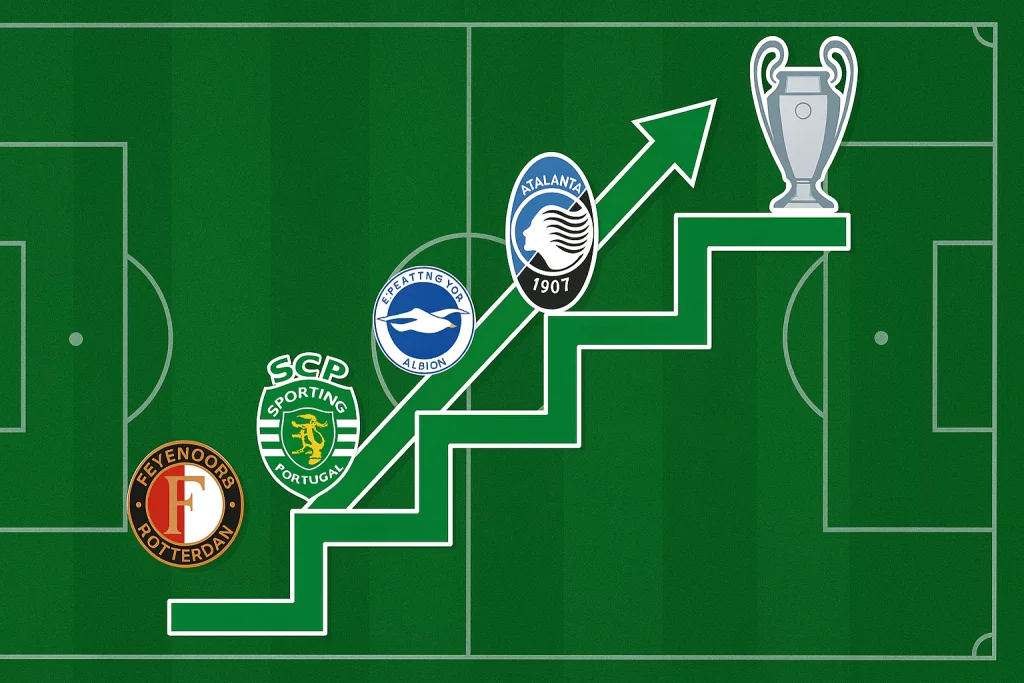
The beauty of football is that there’s always a surprise around the corner. Some clubs are rising fast and could soon join the elite. I’ve kept a close eye on them, and I think they’re just getting started.
Atalanta
Based in Italy, Atalanta have become known for their fearless attacking football. Under Gian Piero Gasperini, they press high, score plenty, and challenge big names.
Watching them is pure fun. They’ve made several deep runs in European competitions and continue to grow.
Brighton & Hove Albion
It’s rare to see a mid-table team in England evolve this quickly. But Brighton are doing just that. With a strong scouting system and smart coaching under Roberto De Zerbi, they’ve shocked top Premier League sides.
They remind me a bit of early 2010s Dortmund—young, hungry, and bold.
Sporting CP
Portugal has always produced talent, and Sporting CP is a big reason why. Players like Cristiano Ronaldo, Bruno Fernandes, and João Mário all came from here.
They combine youth with strong coaching and a rich tradition. I see them making big waves in the next few seasons.
Feyenoord
Dutch football has a proud history, and Feyenoord are keeping it alive. They’ve won the Eredivisie recently and are doing well in Europe too.
What I love most is their commitment to playing beautiful, attacking football while giving chances to academy players.
Real Sociedad
This Spanish club is growing fast. Real Sociedad mixes local talent with smart international signings. Their style is clean, technical, and efficient.
They’re now regulars in European competition and could become a long-term top 4 La Liga side.
FAQ Section
Q1: Which European soccer team has won the most Champions League titles?
That honor goes to Real Madrid. As of now, they’ve won the UEFA Champions League 14 times, more than any other club in Europe. Their dominance in Europe is unmatched, and they’ve set the standard for what success looks like in club football.
I’ve watched many of those finals myself, and their ability to perform under pressure is something I’ve always admired.
Q2: Are European club rankings updated annually?
Yes, they are. UEFA updates its club coefficients each season. These rankings are based on how clubs perform in European competitions over a rolling five-year period.
Clubs earn points for wins, draws, and how far they go in tournaments like the Champions League, Europa League, and Conference League. I often check these rankings to see who’s rising fast and who’s slipping.
Q3: How does the UEFA coefficient affect club rankings?
The UEFA coefficient system is like a scoreboard. It ranks clubs based on performance and affects how many teams each country can send to European tournaments.
For example, the higher a league’s coefficient, the more automatic spots they get in the Champions League. I think it’s a fair way to reward consistency and quality across the board.
Q4: Which league has the most teams in the UEFA top 10?
Right now, the English Premier League dominates the top 10. Teams like Manchester City, Liverpool, and Chelsea are regulars at the top of UEFA rankings.
The Premier League’s high level of competition and big spending give its teams a real edge in Europe. That’s why they’ve had so many clubs reach semi-finals and finals in recent years.
Q5: What team is currently dominating European football?
At the moment, Manchester City is leading the way. They finally lifted the Champions League trophy in 2023 and continue to win big in England.
Their style, coaching, and squad strength make them a team to beat. Watching them play is like watching a masterclass in football. You can follow their latest stats on UEFA’s official site.
Conclusion
European soccer is full of stories, legends, and unforgettable moments. From the unstoppable Real Madrid to the rising stars of Brighton, each team adds something special to the game. Whether you love history, tactics, or pure drama, there’s always something new to learn.
In this guide, I shared the most successful and iconic soccer teams in Europe, why they stand out, and what makes them so exciting to follow. I also looked at the leagues that shape them and the underdogs ready to rise.
Whether you’re just getting into football or you’ve been watching it your whole life like me, these teams are worth your time. Their journey isn’t just about football—it’s about passion, legacy, and love for the sport.
Thanks for reading! If you found this helpful, feel free to share the article, leave a comment with your favorite team, or check out more posts on my blog about how to watch matches, gear reviews, or deep dives into football history.
